


 Continue with Google
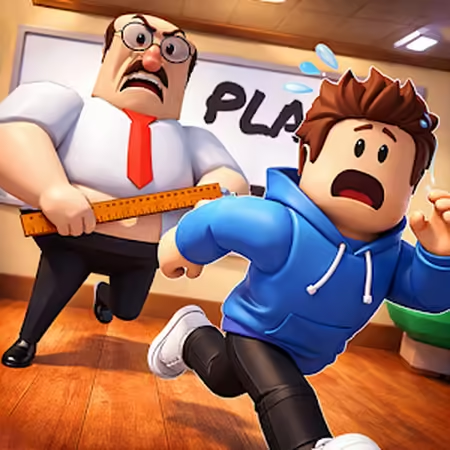
An obby can be explained in seconds: get from here to there without falling. That simplicity is not a weakness. It is the reason the format works so well across Roblox-style experiences, browser games and short play sessions.
Platforming gives players immediate feedback. A jump succeeds or fails. A moving obstacle has a readable rhythm. A checkpoint turns a difficult section into a smaller problem. The rules can stay simple while the level designer keeps changing the challenge.
The first ten seconds are unusually clear
Many online games lose players before the interesting part begins because the interface, controls and goal all have to be learned at once. An obby usually avoids that. Movement is familiar, the destination is visible, and failure is easy to understand. That makes the genre friendly to instant play.

Roblox's own genre research has pointed to interest in open-environment parkour as an evolution of traditional obbies. That makes sense. Once the basic movement language is familiar, designers can expand the format into chase sequences, open routes, combat, vehicles or exploration without forcing the player to relearn everything.
Failure is part of the rhythm
A good obstacle game expects failure, but it tries to make failure cheap. The restart is fast, the player remembers what went wrong, and the next attempt begins before frustration has time to settle in. That creates a compact learn-and-retry loop.
The difficulty curve matters. If every obstacle is trivial, the run has no tension. If the opening is brutally precise, many players leave before they understand the movement. Strong levels alternate pressure with small wins, then use checkpoints to preserve momentum.
Small design choices make a big difference
- Clear silhouettes make hazards readable before the player commits to a jump.
- Consistent physics let skill transfer from one obstacle to the next.
- Short checkpoints reduce repeated busywork after a hard section.
- Camera control matters more as jumps become three-dimensional.
- Optional routes can serve skilled players without blocking everyone else.
Why the format fits browser gaming
Browser games benefit from concepts that do not need a long onboarding sequence. A player can click, understand the objective and start moving. That is especially useful on mobile where a session may begin because someone followed a link rather than deliberately installing a new game.
The web also makes it easy to move between variations. Someone who finishes one parkour game can try a harder course, a themed escape or an action-focused obby without another install. Good internal linking should make those transitions useful, not random.
The genre will probably keep evolving because its foundation is so flexible. A creator can change the theme, movement system, social pressure or progression layer while keeping the central promise intact: learn the obstacle, make the jump, and see what is waiting after the next checkpoint.
Background reading: Roblox, Roblox Genre Insights: What Will You Create Next?.